
How Packaging Influences Consumer Buying Decisions: What Recent Research Reveals
A person who comes to a shop in search of one product may end up buying something else. What made him or her change his or her mind? The price may have done that. Or someone may have recommended it. But sometimes, it is just a package right in front of the customer.
The function of packaging has changed significantly since it was originally meant to protect products during transportation and storage. Nowadays, it can convey product quality, establish product brands, attract attention, create certain expectations, and even make customers think twice before making a purchase.
Now the question is: How does packaging impact consumers’ purchasing behavior? Let’s look at what the research reveals and what brands can learn from it.
Why Packaging Matters Before a Customer Tries the Product
Consumers usually come across packaging prior to interacting with the actual product. Packaging thus turns into a means of communication.
Think about two similar products placed side by side. One will have an ambiguous design, inadequate typography, poor printing quality, and limited information about the product. The second one will have clear visual hierarchy, well-designed graphics, proper color usage, and packaging congruent with the product.
Before even reading all the necessary information, consumers get to set their expectations. This is when packaging comes into play. Packaging is basically a set of cues that consumers rely on when evaluating a product quickly.
Studies of the impact of packaging on consumer behavior indicate that visual features of packaging may become especially significant when it comes to low-involvement purchases.
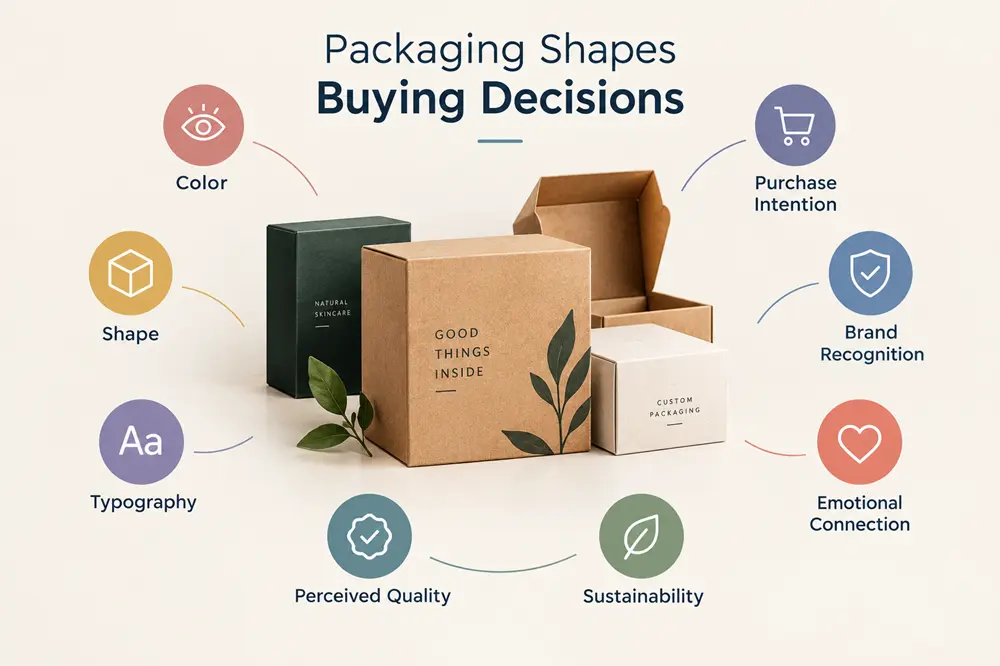
1. Color Can Shape Product Expectations
Color is among the first packaging features that consumers pay attention to. A specific color may give a product impression of vitality, luxury, naturality, youthfulness, sophistication, playfulness, and reliability, among others. But there is no absolute rule about what feelings a certain color causes.
Product category, surrounding products, culture, and design are factors that play a role. A study in the International Journal of Consumer Studies demonstrated that both packaging color and shape influenced consumer preferences and taste perceptions.
Further researches investigate this issue more thoroughly. For example, a 2026 study of food packaging discovered that green packaging may enhance the perception of sustainability of the product; but the effect depends on product category and consumers’ perceptions.
Thus, the key rule for the companies is very clear – one should not choose packaging colors only because they are aesthetically pleasing. One needs to choose colors because they reflect the proper positioning. Premium skincare product, children’s snack, organic tea, and luxury candle require different color choices.
2. Packaging Shape Can Influence Perception
Shape is yet another factor that consumers will be able to process easily. Curved shapes tend to look soft, whereas the angular shape gives off the impression of strength, modernity, or accuracy. Context plays a role in this case, too.
In one study on the packaging of food items, it was found that both shape and color could affect consumer expectations about the product in terms of taste and nutrition.
This aspect is especially helpful for manufacturers that develop unique packaging designs. The product does not need to be put in a standard box because other products on the market utilize the same packaging.
What is important is balance. A unique box design that is hard to open or store may draw attention but negatively impact the entire customer experience.
3. Typography Helps Customers Understand the Product
An attractive package will not work if consumers cannot comprehend it. Typography impacts the elements of legibility, hierarchy, personality, and branding. The typography of the brand name could say one thing while the typography of the product information could say another.
However, more importantly, consumers have to be able to identify key information.
Usually, an effective hierarchy in packaging ensures that the following information becomes clear:
- The product itself
- The brand producing the product
- Why it is unique
- Quantity included
- Key product information
Studies of packaging and purchase intention also now include typography in addition to packaging design, materials, and other aspects. In a 2025 study of perfume packaging, for instance, the design, materials, and fonts were found to greatly influence purchase intentions.
This is why typography cannot be considered a mere decoration.
4. Packaging Can Signal Product Quality
Consumers cannot always make their own judgment about the quality of the product before purchase.
Packaging can make up for some of that information deficit. High quality print, high quality material, proper finishing, proper construction, and proper structural design may form an expectation of what is inside. It is not necessary for high cost packaging to imply higher quality products. Rather, the package itself should reflect the quality level that the brand intends consumers to associate with the product.
For instance, a high-end perfume in a properly structured rigid package gives off a different vibe than the same perfume in a simple carton package.
The package becomes an integral part of the overall product experience. This is especially true in case of high-end products as the consumers expect something else from such products besides functionality.
5. Packaging Builds Brand Recognition
Consider some brands with which you can identify the packaging even if you don’t read the name. This is something of great value. Packaging designs may consist of colors, shapes, typography, graphics, and structural features that make them identifiable in general. With time, customers will start associating all of these things with the specific brand.
In this way, packaging acts as an extension of branding. There is no need to consider each box design individually; one can come up with packaging system with recognizable brand elements, yet distinctive designs for different products.
This is extremely useful for companies having several SKUs. The customer should be able to recognize the product despite it being new to him/her.
6. Packaging Creates Emotional Responses
Purchase decisions are not entirely rational all the time. The packaging may arouse curiosity, anticipation, nostalgia, trust, or even luxury without the consumer having to open the package.
This is one of the reasons why unboxing has now become a crucial element of the modern customer experience. It transforms any delivery into a brand experience.
New research done on visual packaging elements reveals that there is a link between design and purchase intentions via brand experience. This is important as consumers could remember their feelings when interacting with the product more than the design itself.
7. Product Information Can Reduce Purchase Uncertainty
In addition to conveying information, a package must serve the purpose of answering questions. People might ask what is inside the package, how it is supposed to be used, its place of origin, quantity of goods or whether or not it suits them.
Lack of information leads to uncertainty while too much information causes visual pollution. The task of packaging is to provide useful communication. According to previous studies about packaging and purchasing behavior, consumers are dependent on label information but would prefer it to be streamlined.
8. Sustainable Packaging Is Changing Consumer Expectations
Sustainability is also becoming more and more relevant in packaging discussions. The consumer may judge the product based on materials used in the packaging, its recyclability, amount of waste, and sustainability claims. Just putting words like “eco-friendly” on the box is insufficient.
It has been proven by the research that both the aesthetics of the packaging and the sustainability claims could affect consumer’s perception of the packaging sustainability and ethics of the brand. Moreover, recent research has also indicated that the material used in packaging affects consumers’ perception of sustainability and value. For example, Kraft boxes can be a way for brands to package their products for those who wish to have an eco-friendlier packaging choice. The packaging looks like paper, and thus conveys simplicity and eco-friendliness through the right material and packaging claims. If a brand wants its packaging to look more natural than manufactured, then this type of packaging can help with creating its unique look.
9. Packaging Can Build Brand Trust
Trusting a company is especially critical if a customer is not aware of the brand. Poor packaging may lead one to ask questions regarding the quality of the product in question. On the other hand, proper packaging may indicate that the company is detail-oriented.
10. Packaging Works Differently Across Products
No specific packaging equation can apply to all product categories. A snack brand might require high visibility on the shelf; a luxury candles brand might prefer to go with sensory packaging and premium quality; a cosmetics brand may opt for elegant packaging and uniformity; a subscription company will stress the importance of unboxing.
Even within the same product category, consumer reactions can be diverse in regard to the level of engagement and the purchasing environment.
Research has confirmed over and over again that the effects of packaging are context-dependent, which is why companies should start their packaging strategies with the customer and the purchasing environment in mind, and not just with some fashion trends.
How to Create Packaging That Influences Buying Decisions
Some of the factors that brands must take into consideration when improving their packaging are:
Start with Your Consumer
Know your consumer, where they see your product, and what they care about.
Determine the Brand Positioning
Know if your product needs to be seen as luxurious, inexpensive, sustainable, fun, sophisticated, classic, or innovative.
Visual Hierarchy Comes First
Ensure that the consumer can easily identify your brand name and product type.
Use Material Wisely
Material influences aesthetics, functionality, tactile experience, sustainability perception, and sometimes the perceived value of your product.
Structure Your Design
Custom packaging and unique structures can help make your product stand out, but always keep functionality in mind.
Test Before Mass Manufacturing
Mock-ups, prototypes, and consumer testing can show flaws before it is too late.
Final Takeaway
The relationship between packaging consumer buying decisions is no longer something brands can afford to overlook. There have been various studies conducted to show how packaging may affect attention, expectations, quality perception, brand experience, trust, sustainability perceptions, and purchase intention.
However, good packaging is not about creating the most aggressive packaging on the shelf.
Good packaging is about creating the right impression. As a result, when the packaging is speaking the same language as the company and the product, when it protects the product, creates an appealing experience for the consumer, and makes him trust what is inside the package, it goes far beyond packaging and becomes a part of the sales strategy.
In other words, the first impression can make all the difference in a highly competitive market environment.
With BlueBox Packaging, brands can use that first impression to give your brand packaging that purposefully creates a custom experience built on your brand, products, and customers’ expectations. Proper packaging is more than just holding your product; it helps to introduce your product before the customer even opens it.

James Clark
James is a senior editor, expert in the packaging industry. With a keen eye for detail and industry expertise, he crafts engaging narratives that explore the latest trends and innovations in packaging design and sustainability.