
How to Measure a Box? A Complete Guide
Understanding how to measure a box is one of the fundamentals of packaging and shipping operations, logistics, warehousing, and e-commerce. It might appear quite an easy activity at first, but measuring the dimensions of a box has a significant impact on the determination of the shipping rates, effectiveness of product packaging, and the overall effectiveness of supply chain management activities. Sometimes, just a slight miscalculation in box dimensions causes excessive expenses for freight, inappropriate size of goods, and wastage of materials.
Nowadays, packages are no longer seen as mere containers but rather as measured units of space and expense. Shippers now assess their packages according to a uniform set of dimensional standards that will affect the way they are priced, stored, and moved. Thus, accurate measuring is critical for companies that wish to prevent any potential monetary damage due to dimensional pricing and inconsistent packaging dimensions between products.
The following guide will provide you with a practical overview of box dimensions to help you make better packaging decisions.
The Industry Standard: L x W x H Protocol
There is a standard approach to measuring a box that is followed internationally:
Length x Width x Height (L x W x H)
It is a clear structure that is used by packaging, manufacturing, and logistics professionals in order to make sure that box dimensions will be consistently understood in any country and for any packaging material. The supplier, manufacturer, and shipper will be able to understand what dimensions are specified when they see the numbers.
Dimensions explanation:
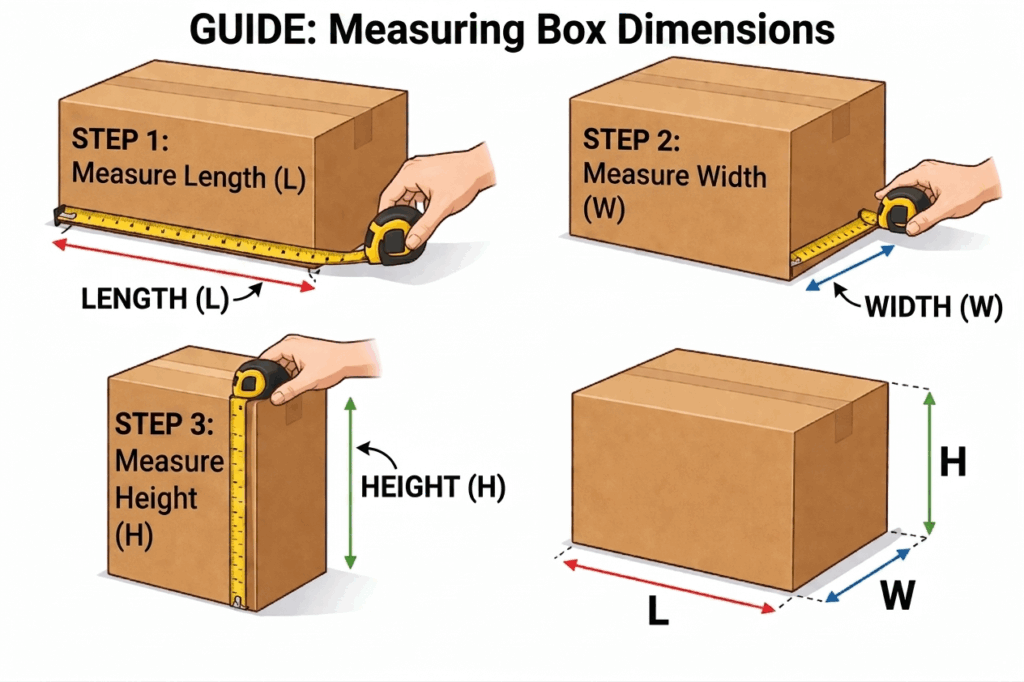
Length (L): It is the longest side of the opening of the box, which can also be called a reference point when box dimensions have to be specified.
Width (W): It is the shorter side of the box, which runs perpendicularly from its length and defines the second horizontal distance between two sides of the packing.
Height (H): It is the vertical measurement of the box, which starts at the bottom of the box and ends with the opening.
Tools Required for Accurate Box Measurement
The following tools ensure professional accuracy:
Steel Tape Measure
Helps avoid stretching mistakes that often occur using cloth tapes.
Carpenter’s Square
Used to align everything accurately at 90 degrees before measurements.
Digital Calipers
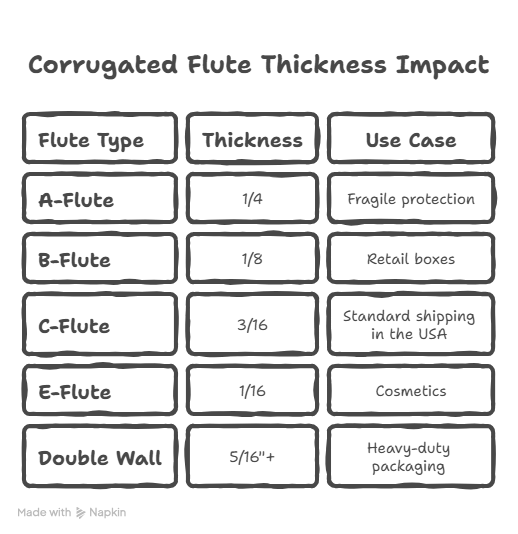
For measuring material thickness (flute size), essential for internal/external accuracy.
Flat Surface
Uneven flooring can cause height measurements to be off by half an inch.
Step-by-Step Guide: How to Measure a Box Correctly
The accurate way to determine the measurements of boxes is to adhere to an appropriate methodology that is followed throughout the packaging, logistics, and manufacturing sectors.
1. Place the Box on a Flat Surface
Begin by positioning the box on a steady flat surface like a table top or ground. Ensure that the box is completely assembled and oriented correctly. Inaccuracies may occur from using an unstable or cushioned surface, particularly when trying to measure height, since this is important for correct box dimensions.
2. Identify and Measure the Length
Measure the longest edge of the box opening.
- It is measured from edge to edge
- Do not measure the curved area
- Always keep the tape straight while measuring
3. Measure the Width
It gives the smaller horizontal dimension of the box opening.
- Take measurements, ensuring a 90° alignment
- Avoid taking measurements diagonally
- Accurate recording is important
- Record carefully for consistency
4. Measure the Height
Then, measure the height of the box. The height of the box should be measured vertically, starting from the bottom of the box up to the upper opening.
- Do not consider flaps when measuring height unless needed.
- The height of a box may also be called “depth” for packaging purposes.
5. Record the Final Dimensions
When you have taken all your measurements, be sure to write them down using the standard industry measurement system:
Length x Width x Height (L x W x H)
For example,
12 x 8 x 6 inches
This is how standard dimensions are listed in order to avoid confusion when manufacturing and transporting the boxes.
Internal vs External Dimensions
One of the most important aspects of measuring the box is learning ID and OD.
Internal Dimension (ID)
Used for fitting and packaging.
- Fits your product properly
- Provides extra room for easy installation
- For instance, a 12-inch item will have a roughly 12 1/8-inch internal box
External Dimension (OD)
Used for transportation and logistics costs.
- Contains material width
- Determines your shipping price
- Used by all shipping companies
- The corrugated wall adds 1/2-inch overall measurement
Measuring Different Box Types
Various types of packaging structures are evaluated using different metrics.
A. RSC Boxes (Regular Slotted Cartons)
These boxes are the most popular and widely used for shipping packages both in warehouses and e-commerce companies.
- Fully assemble the box first
- Measure the external dimensions (not internal ones)
- Write down the dimensions of Length x Width x Height according to the external size of the box
- Close the flaps when measuring the box
B. Mailer Boxes
Mailer boxes are self-locking boxes and very popular among retailers.
- Measure the internal dimension of the tray (internal space)
- Don’t measure only the external dimension since walls overlap in the internal space
- The external measurement will be bigger than the internal one and provide a wrong capacity estimation
C. Telescope Boxes
These consist of two parts: the base and the lid, which fits into the base.
- The first step is to measure the base since it establishes the product’s space.
- The lid provides more height but is not included in the space used.
- There should be a slight gap for easier closing (about 1/16 inch).
- Don’t measure it too tightly to avoid problems during closing.
D. FPF Boxes (Folder-Type Packaging)
These folder-type packages are long, folded structures commonly used for flat or elongated products.
- Measure the overall structure when completely assembled
- Internal usable dimension should be emphasized
- Used for objects like prints, fabrics, or narrow products
- Make sure all folds and corners are correctly aligned before measuring
E. Tubes
These are used for posters, documents, or rolled items.
- For use in posters, paperwork, or other things that roll up.
- Measure the diameter (the width across the circle)
- Measure the entire height (the length of the tube)
- Make sure to take into account the ends in the height calculation
G. Irregular Boxes
These are irregularly shaped packages that cannot fit into a square or rectangular shape.
- Envision placing the package in an ideal square or rectangular shape.
- Determine the highest points of length and width, and height.
- Consider any protrusions or irregularities during the measurement process for correct measurement.
How to Measure a Box for Shipping
The process of shipping always takes exterior dimensions:
- The box must be closed completely
- Bulges and pressure expansions to be considered
- Only take the outer dimension
- Always round up
The carriers will compute on the following basis:
length × width × height
Any mistakes in the measurements can result in increased shipping charges.
Professional Packaging Workflow
There is no guessing involved when experts determine the box size. The process involves:
- Product measurements of its extremities
- Allowance for cushioning clearance
- Selection of the appropriate box design
- Consideration of the flute thickness
- Prototyping
- Packing testing
Why Exact Fit Is a Mistake
The perfect-fit package does not work during shipping:
- creates pressure damage
- creates difficulties in packing
- creates friction damage
Therefore, clearance space is always necessary.
Why Box Measurement Impacts Business Profit
Incorrect sizing affects:
- shipping cost (DIM inflation)
- warehouse space usage
- return rates
- packaging waste
A 1-inch increase can shift pricing into a higher billing bracket.
Real-World Insights
Measurement of the box is not merely a matter of size, but it serves as a cost projection tool for logistics professionals.
Each added inch will impact:
- pallet loading density
- truck/container utilization
- air freight volumetric billing
- storage slot allocation
For example, in pallet planning, an increase of one inch in each direction can cut efficiency by 12%–18%, lowering the number of products per shipment and thus raising the cost per unit.
That’s why in the USA, packaging companies such as BlueBox Packaging don’t simply measure boxes but use logistics economics to design their packaging dimensions.
Why Box Measurement Also Affects Sustainability
Right-sized packaging reduces:
- corrugated waste
- void fill materials
- carbon footprint per shipment
Modern brands now use optimized box dimensions as part of ESG goals.
Final Thoughts
Knowing how to determine the size of a box is a technical and economic competency that will have a direct effect on the box’s performance and its associated costs.
Through:
- LxWxH formula
- Interior vs exterior sizes
- Effect of flute sizes
- DIM pricing strategy
- Actual system procedures
You will have full command over your package’s effectiveness.
FAQs
How can you get the size of the box for shipping purposes?
The outer height, length, and width are measured, making sure that the box is completely enclosed, and then rounding it off.
What measurements will the delivery company use?
Delivery companies use only the external measurements to compute the cost of delivering packages.
What is the typical mistake when measuring boxes?
Confusing the length and the width, as well as forgetting the thickness of the material used.
What is the importance of clearance in packaging?
Clearance ensures that the package fits properly inside without being harmed due to pressure.

James Clark
James is a senior editor, expert in the packaging industry. With a keen eye for detail and industry expertise, he crafts engaging narratives that explore the latest trends and innovations in packaging design and sustainability.