
The Ultimate Guide To Playing Card Dimensions
Most people are familiar with a deck of playing cards. No matter where you get it, it is simple, easy to use, and feels reliable. However, this consistency is the result of precise sizing choices that have been improved over time. Those features are important to businesses and designers. The correct dimensions have an impact on printing accuracy, usefulness, and even the market perception of your product.
If you’re planning to create custom decks or packaging, understanding playing card dimensions is a good place to start. Bluebox Packaging offers high-quality services to meet your packaging and printing needs for playing cards.This guide provides a clear and useful explanation of playing card sizes.
Why Playing Card Size Matters
Before going into what size playing cards are, it’s important to understand why size is even considered in the first place. Card dimensions affect usability, readability, and presentation. If the proportions are not balanced, the cards may feel or look poorly designed. For businesses, this can directly impact how customers perceive their product.
A well-sized card ensures:
- Easy handling
- Clear visibility of design elements
- Smooth shuffling and dealing
- Compatibility with packaging
This is why choosing the correct size of playing cards is a practical decision, not just a design choice.
Standard Playing Card Size
The most used dimensions of playing cards are 3.5 inches (6.35 cm x 8.89 cm) in height and 2.5 inches in breadth. This size is considered standard in the gaming and printing industry. It is also considered appropriate for the majority of card games since it provides a mix between comfort and functionality. Its popularity also makes it simpler to manufacture and package.
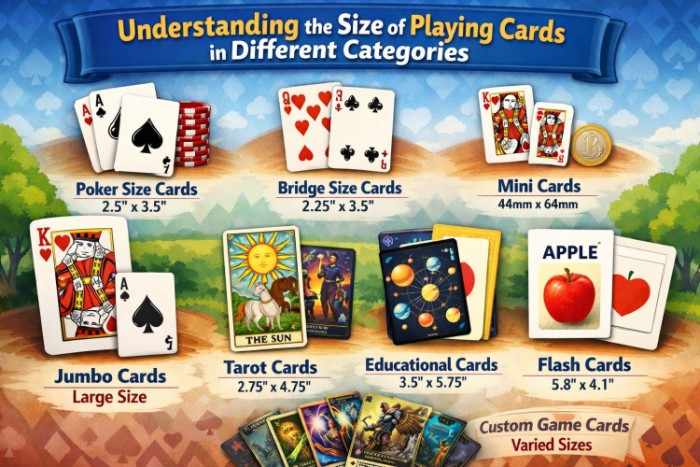
Understanding the Size of Playing Cards in Different Categories
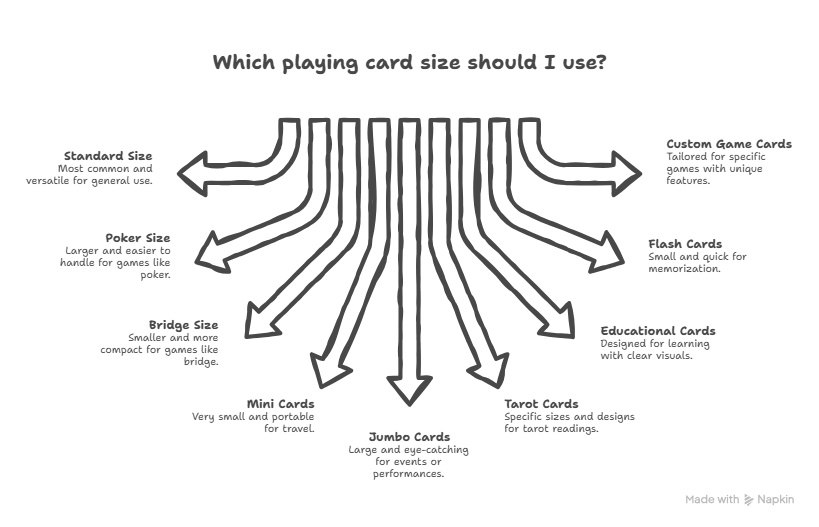
Although the standard size is the most often used, some cards use different versions. These choices fall into various playing card sizes, each of which was created with a particular purpose in mind.
Poker Size Cards
The most commonly used poker card dimensions are 2.5 by 3.5 inches (63.5 x 89 mm).
Poker cards are commonly used in casinos and casual gaming because of their comfortable width and handling. If you’re looking to create a custom deck or playing card boxes for your next poker night, our exceptional printing services ensure that your unique designs will be noticed.
Bridge Size Cards
Bride size cards are simpler to handle as they are slightly narrower than poker cards. Their standard playing card size is 2.25 x 3.5 inches (57 x 89 mm). They are frequently used in games where holding multiple cards is necessary.
Miniature Cards
Miniature cards are smaller compared to regular cards, as suggested by their name. They are utilised for novelty or travel games when portability is required. The standard dimensions of the mini playing card deck are 44 mm by 64 mm, or around ¾ of an inch in width and 1 3/8 inches in height.
Jumbo Cards
Jumbo Cards are usually A5, A4, or larger, and are even bigger. They are usually used for promotions, events, or demonstrations where visibility is more important than convenience because they are larger in size.
Tarot Cards
Tarot cards are bigger than regular cards, usually measuring 2.75 x 4.75 inches (70 x 120 mm). Their larger size makes it possible to clearly display symbolic elements and detailed artwork. To ensure that every detail of each distinctive Tarot card is flawlessly produces have a look at our custom printing services.
Educational Cards
Educational cards come in a variety of sizes, measuring 3.5 by 5.75 inches (89 x 146 mm). These cards are in larger sizes to fit more text, graphics, or information. You can create visually appealing and informative educational cards using our best printing services.
Flash Cards
They commonly measure 5.8 x 4.1 inches (148.5 x 105 mm). They are used for learning or teaching purposes so they are designed bigger to be easily read from a distance and handled comfortably.
Custom Game Cards
Dimensions of custom game cards differ based on your specific game requirements. The sizes are distinct, providing the precise components that fit the cards perfectly, which in turn improves the gaming experience. Consider using our custom printing services; we will make your playing cards in the best quality, tailored to your specific dimensions and gaming needs.
Card Thickness and Material Quality
Another important factor in a card’s performance is its thickness, which depends on the material of cardstock used. The majority of playing cards are composed of coated, stacked paper with a thickness varying from 0.30 to 0.33mm.
Benefits vary depending on the finish and cardstock used:
- Gaming Linen: It has a thickness of around 0.3mm. Gaming linen is used to enhance grip and add texture. These cards have a black core to reduce transparency.
- Casino Linen: It has a thickness of about 0.31 mm. It’s a refined option with a linen finish and air pockets that improve its longevity and slickness. They have a dark core to stop light from penetrating.
- Premium Smooth: It offers a sleek and spotless appearance. Premium Smooth (PS30) has a thickness of about 0.33 mm. It has a clean surface and a blue core center for reduced transparency.
- Deluxe Smooth: It is one of the best cardstocks available, with a smooth texture approximately 0.31 mm thick.
Common Mistakes to Avoid
When creating playing cards, little errors can eventually cause more problems.
Common errors include:
- Neglecting margins and print bleed
- Selecting the wrong thickness
- Using odd sizes randomly
- Ignoring the design of the packaging
Keen attention to these details can reduce production costs and time. High-quality printing services can ensure accurate card dimensions to make sure that these errors do not affect the quality of cards or your gaming experience.
The Role of Playing Card Boxes
Packaging is just as important as the cards themselves. Playing card boxes are designed to protect the deck while also enhancing its presentation. While tuck boxes remain a simple and practical choice, many brands are now moving toward more premium and custom options to stand out.For example, businesses offering collectibles or trading decks often invest in our sports card boxes to ensure durability and a more professional display. Moreover, magnetic closure boxes and rigid boxes are also being used to achieve a more premium visual effect.
Why Playing Card Repack Boxes Are Useful
Businesses frequently wish to improve their packaging without altering the cards. Playing card repack boxes are useful in this case. They enable companies to revamp the external packaging for improved marketing or presentation.
They are frequently employed for:
- Limited-edition publications
- Rebranding of products
- Packaging for gifts
- Campaigns for promotion
This strategy aids companies in being adaptable while preserving product quality.
Final Thoughts
Designing playing cards involves more than just artwork. Size, thickness, and packaging all work together to create the final product. Understanding dimensions of playing cards helps ensure that your cards are functional, visually balanced, and easy to use. It also makes the production process smoother.
At Blue Box Packaging, we focus on delivering packaging and printing solutions that match your product requirements and brand identity. From standard boxes to custom printing styles, every detail is handled with precision. If you are planning to create your own deck, choosing the right size and packaging will make all the difference.
FAQs
1. What are the standard playing card dimensions?
The standard playing card size is 2.5 x 3.5 inches (63.5 mm x 88.9 mm). This size is commonly used for most card games and is widely accepted in the gaming and printing industry.
2. What size are playing cards used in casinos?
Most casinos use poker-size cards, which follow the standard dimensions of 2.5 x 3.5 inches. This size is easy to handle and suitable for games like poker and blackjack.
4. Why is the size of playing cards important?
The size of playing cards affects how the cards feel, how easy they are to handle, and how clear the design looks. Proper sizing of your playing cards improves both usability and overall gaming experience.
5. What is the best packaging for playing cards?
The best packaging depends on your needs. Tuck boxes are commonly used, but rigid boxes and magnetic closure boxes offer a more premium look. Custom options like our sports card boxes are also popular for collectible decks.
6. Can I customize the playing card size and packaging?
Yes, both card dimensions and packaging can be customized based on your requirements. You can use our custom printing services to get your playing card size and packaging tailored according to your needs.

James Clark
James is a senior editor, expert in the packaging industry. With a keen eye for detail and industry expertise, he crafts engaging narratives that explore the latest trends and innovations in packaging design and sustainability.