
What Are Corrugated Boxes? Types and Their Uses
When businesses need packaging that is strong, practical, affordable, and easy to customize, corrugated boxes are one of the most reliable choices available. From shipping products across the country to protecting retail items on store shelves, these boxes are used in nearly every industry.
But what exactly are corrugated boxes, and why are they so widely used?
Unlike ordinary paperboard packaging, corrugated cardboard boxes are made with multiple layers of paper that create a fluted inner structure. This construction gives the box greater strength, cushioning, and resistance to pressure. Depending on the product, shipping requirements, and branding goals, businesses can choose from several types of corrugated boxes, including single-wall, double-wall, and triple-wall options.
This guide explains what corrugated boxes are, how they are made, the different types available, and where they are commonly used. Whether you operate an eCommerce store, retail business, manufacturing company, or subscription brand, understanding corrugated packaging can help you choose the right solution for your products.
What Are Corrugated Boxes?
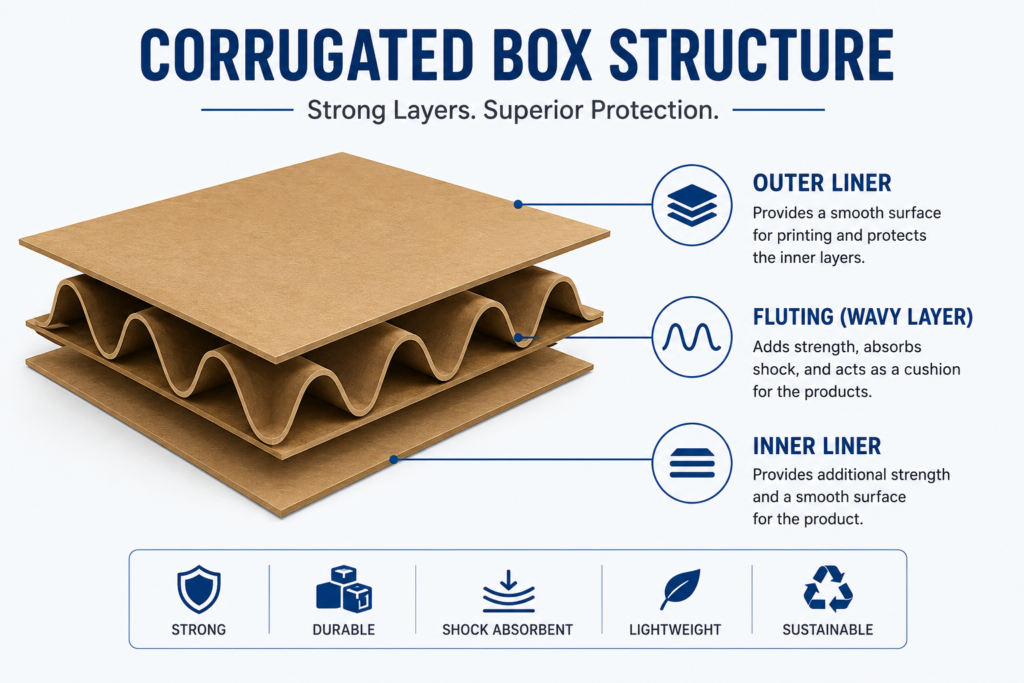
Corrugated boxes are packaging containers made from a corrugated fiberboard material consisting of a fluted sheet positioned between one or more flat linerboards. The fluted layer creates air pockets that add strength and provide cushioning for the products packed inside.
The familiar shipping boxes used by online retailers are typically corrugated cardboard boxes. Their structure makes them much more durable than standard folding cartons or lightweight paperboard packaging.
A corrugated box generally consists of three primary components:
- Outer liner: The outside paper layer that provides durability and creates a surface for printing.
- Fluting: The wavy middle layer that provides structural strength and cushioning.
- Inner liner: The inside paper layer that supports the product and reinforces the overall construction.
This layered design makes corrugated packaging boxes suitable for everything from lightweight consumer goods to heavy industrial products.
How Are Corrugated Boxes Made?
The manufacturing process behind corrugated cardboard packaging is relatively straightforward but highly engineered to produce consistent strength and performance.
First, paper is processed to create the fluted medium. The paper passes through heated rollers that shape it into the characteristic wave pattern. Adhesive is then applied to attach the fluted material to one or more linerboards.
Depending on the required strength, manufacturers can create different structures, such as single-wall, double-wall, or triple-wall corrugated board.
Once the board is produced, it can be cut, creased, folded, printed, and converted into the desired box style.
The result is a lightweight yet strong packaging material that offers excellent compression strength, impact resistance, and product protection.
Corrugated vs. Cardboard: What’s the Difference?
The terms cardboard and corrugated cardboard are often used interchangeably, but they are not exactly the same.
Cardboard is a broad term that generally refers to thick paper-based packaging material. It can include paperboard used for cereal cartons, cosmetic packaging, and retail boxes.
Corrugated cardboard, on the other hand, contains a fluted middle layer between liner sheets. This structure gives it significantly more strength and makes it better suited for shipping and transportation.
For example, a lightweight cereal carton may use paperboard, while a shipping package containing multiple products would typically use a corrugated box.
This difference is important when selecting packaging because the best material depends on the product’s weight, fragility, shipping distance, and handling conditions.
Types of Corrugated Boxes
There are many corrugated box types, and each one is designed for specific packaging requirements. Choosing the right structure can improve product protection while helping businesses control packaging and shipping costs.
1. Single-Wall Corrugated Boxes
Single-wall corrugated boxes are among the most commonly used packaging options. They contain one fluted layer sandwiched between two linerboards.
They provide a good balance of strength, weight, and affordability, making them suitable for everyday shipping applications.
These boxes are commonly used for:
- eCommerce orders
- Apparel and footwear
- Books and stationery
- Household products
- Small electronics
- Food products
- Subscription boxes
Because single-wall boxes are lightweight, they can also help businesses reduce unnecessary shipping weight.
For many businesses, single-wall corrugated packaging offers enough protection without requiring a heavier box construction.
2. Double-Wall Corrugated Boxes
When additional strength is required, businesses can choose double-wall corrugated boxes.
As the name suggests, double-wall board contains two layers of fluting separated and supported by linerboards. This creates a thicker and stronger structure than a single-wall board.
Double-wall boxes are ideal for products that are:
- Heavy
- Fragile
- Bulky
- High-value
- Shipped over long distances
They are widely used for industrial products, appliances, automotive parts, large retail orders, and warehouse shipments.
Because the construction provides additional stacking strength and puncture resistance, double-wall packaging can perform better when boxes are stored on pallets or stacked during transportation.
3. Triple-Wall Corrugated Boxes
For particularly demanding applications, triple-wall corrugated boxes provide an even higher level of protection.
These boxes contain three layers of fluting and are built for heavy-duty packaging requirements. They can carry significantly heavier products and withstand challenging handling conditions.
Triple-wall boxes are often used for:
- Industrial equipment
- Machinery components
- Large automotive parts
- Heavy tools
- Commercial equipment
- Export shipments
Although they require more material than standard boxes, they can reduce the risk of product damage during transportation.
4. RSC Corrugated Boxes
The Regular Slotted Container, commonly known as an RSC box, is one of the most widely recognized shipping box styles.
RSC boxes feature flaps that meet at the center when folded. They are simple to assemble, economical to manufacture, and suitable for a broad range of products.
Their versatility makes RSC corrugated boxes popular in warehouses, fulfillment centers, distribution facilities, and eCommerce businesses.
They can be sealed using packing tape, staples, or other closure methods, depending on the application.
5. Die-Cut Corrugated Boxes
Die-cut corrugated boxes are produced using specialized cutting and creasing equipment, allowing manufacturers to create precise shapes and unique structural designs.
Unlike standard shipping cartons, die-cut boxes can include custom openings, locking tabs, handles, inserts, and other features.
Businesses often use custom die-cut boxes for retail packaging, subscription products, promotional kits, food packaging, and branded shipping experiences.
Their precision also allows brands to create packaging that fits a product closely, reducing excess space and minimizing movement inside the box.
6. Corrugated Mailer Boxes
Corrugated mailer boxes are designed for direct-to-consumer shipping while also creating a more polished unboxing experience.
These boxes often feature self-locking construction, making them easy to assemble without extensive use of tape.
They are popular with:
- eCommerce brands
- Subscription services
- Beauty companies
- Apparel businesses
- Promotional products
- Gift companies
With custom printed corrugated mailer boxes, businesses can turn a standard shipping package into a branded customer touchpoint.
7. Corrugated Shipping Boxes
Corrugated shipping boxes are specifically designed to protect products during transportation and distribution.
They are available in different board grades and constructions based on the size and weight of the product. Strong shipping cartons can withstand stacking, vibration, compression, and general handling during transit.
For businesses shipping products nationwide, the right shipping box can make a significant difference in reducing damage and improving delivery efficiency.
8. Custom Corrugated Boxes
When standard packaging does not meet a product’s requirements, businesses can choose custom corrugated boxes.
Custom boxes can be manufactured according to specific dimensions, product shapes, brand requirements, and shipping conditions.
Customization may include:
- Custom box dimensions
- Printed logos
- Brand colors
- Custom graphics
- Die-cut windows
- Handles
- Inserts
- Dividers
- Protective padding
- Special closures
This makes custom corrugated packaging especially useful for businesses looking to balance product protection with branding.
Common Uses of Corrugated Boxes
One of the biggest advantages of corrugated packaging is its versatility. It can be adapted for industries ranging from retail and eCommerce to manufacturing and food distribution.
eCommerce Packaging
Online retailers depend heavily on corrugated shipping boxes because products must travel through multiple stages of handling before reaching customers.
A properly sized box can help protect the product while reducing unnecessary void space.
Brands can also use custom-printed corrugated boxes to create a branded experience from the moment the package arrives.
Retail Packaging
Corrugated materials are also widely used in retail environments. Retail corrugated boxes can serve as both transportation packaging and product displays.
Businesses can incorporate graphics, product information, branding, and promotional messaging directly onto the packaging.
Food and Beverage Packaging
Corrugated boxes are commonly used for transporting packaged foods, beverages, produce, and other consumable products.
Depending on the application, businesses may use specialized food-grade corrugated packaging designed to meet particular handling and packaging requirements.
Corrugated cases can also be combined with liners, dividers, and protective inserts to keep food products organized and secure.
Electronics Packaging
Electronics often require careful protection because they may be sensitive to impact, vibration, and pressure.
Corrugated boxes for electronics can be designed with internal inserts or partitions that keep the product from shifting during transportation.
For high-value electronics, combining a strong outer carton with specialized protective materials can provide additional security.
Apparel and Fashion Products
Although clothing generally does not require extremely heavy-duty packaging, corrugated boxes for apparel provide a practical way to ship folded garments, shoes, accessories, and fashion products.
Custom printing can also transform a standard shipping package into an extension of a fashion brand’s visual identity.
Industrial and Manufacturing Applications
Manufacturers frequently rely on heavy-duty corrugated boxes to transport machinery parts, tools, components, and industrial products.
Double-wall and triple-wall structures are particularly valuable when the contents are heavy or require enhanced protection.
Subscription Boxes
Subscription brands have made custom corrugated mailer boxes increasingly popular. These packages need to be durable enough for shipping while also providing an attractive unboxing experience.
Branded printing, compartments, inserts, and custom dimensions allow subscription businesses to build memorable packaging experiences.
Benefits of Using Corrugated Boxes
The popularity of corrugated packaging comes from a combination of practical and commercial benefits.
Strong Product Protection
The fluted structure helps absorb impacts and distribute pressure, providing a protective layer around products during storage and transportation.
Lightweight Construction
Despite their strength, corrugated boxes are relatively lightweight. This can make them easier to handle and potentially help businesses manage shipping costs.
Cost-Effective Packaging
Corrugated boxes wholesale options can be an economical choice for businesses shipping products at scale. Their straightforward construction and broad availability make them practical for both small businesses and large manufacturers.
Easy Customization
Corrugated packaging can be customized in terms of size, structure, printing, and internal components.
Stackability
Well-designed corrugated cartons provide strong stacking strength, which is particularly important for warehouse storage and palletized shipping.
Recyclability
Paper-based corrugated materials are widely associated with recycling programs, making recyclable packaging a popular consideration for brands seeking more sustainable packaging choices.
How to Choose the Right Corrugated Box
Choosing a corrugated box should go beyond simply selecting a size. Several factors influence packaging performance.
Consider Product Weight
Light products may only require single-wall board, while heavier products may benefit from double-wall or triple-wall construction.
Measure the Product
The box should provide enough room for the product and any necessary protective materials without leaving excessive empty space.
Consider Fragility
Fragile products may require additional cushioning, dividers, inserts, or stronger board construction.
Think About Shipping Conditions
Products traveling through multiple distribution centers may experience more handling than items delivered locally. Long-distance shipping may justify stronger corrugated shipping packaging.
Evaluate Branding Requirements
For consumer-facing products, custom printing can turn ordinary packaging into a valuable branding opportunity.
Consider Storage
Boxes should also fit efficiently on pallets, shelves, and warehouse storage systems. Efficient packaging dimensions can help businesses maximize available space.
Corrugated Boxes and Sustainable Packaging
Sustainability has become an important consideration in modern packaging decisions. Because corrugated packaging is paper-based, brands often consider it when developing eco-friendly packaging solutions.
Corrugated material can be sourced from paper fibers and is widely recyclable where appropriate recycling infrastructure is available. Businesses can also improve packaging efficiency by selecting the correct box size and minimizing unnecessary materials.
However, sustainability depends on the complete packaging system. Factors such as sourcing, coatings, inks, adhesives, shipping distance, and recycling availability should all be considered.
For brands working toward more responsible packaging strategies, sustainable corrugated packaging can be one part of a broader packaging plan.
Corrugated Boxes vs. Rigid Boxes
Corrugated and rigid boxes serve different purposes in packaging.
Corrugated boxes are generally lightweight, durable, and highly practical for shipping and transportation. They are especially useful when products need to be distributed through various networks.
Rigid boxes, on the other hand, are made from thicker paperboard and are commonly associated with premium product presentation and luxury packaging.
A luxury fragrance brand, for example, may use a rigid box for the primary retail presentation while using a corrugated shipping carton to protect that package during delivery.
In many cases, the two packaging types work together rather than competing with one another.
Get Custom Corrugated Boxes from Blue Box Packaging
The right packaging should do more than hold a product – it should protect it, support your logistics, and represent your brand.
At Blue Box Packaging, businesses can create custom corrugated boxes tailored to their product dimensions, shipping requirements, and branding goals. From dependable corrugated shipping boxes to custom printed packaging and specialty structures, the right box can be designed around your specific needs.
Whether you need packaging for eCommerce fulfillment, retail distribution, subscription products, food items, apparel, or industrial goods, custom packaging can help improve both protection and presentation.
Ready to find the right packaging for your products? Contact Blue Box Packaging for custom corrugated boxes designed around your business.
FAQs
1. What are corrugated boxes?
Corrugated boxes are packaging boxes made from a fluted paper layer between linerboards, providing strength and cushioning.
2. What are the main types of corrugated boxes?
The main types include single-wall, double-wall, triple-wall, RSC, die-cut, and custom corrugated boxes.
3. Are corrugated boxes good for shipping?
Yes. Corrugated shipping boxes are lightweight, durable, stackable, and designed to protect products during transportation.
4. Can corrugated boxes be customized?
Custom corrugated boxes can be made in different sizes, shapes, printing styles, and structures to suit your products and branding.
5. Are corrugated boxes recyclable?
Yes. Corrugated boxes are paper-based and are widely recyclable where suitable recycling facilities are available.

James Clark
James is a senior editor, expert in the packaging industry. With a keen eye for detail and industry expertise, he crafts engaging narratives that explore the latest trends and innovations in packaging design and sustainability.