
Rigid Box Dimensions: Complete Size Guide for Luxury Packaging
The selection of suitable rigid box dimensions is one of the most crucial tasks in the process of premium packaging. It will not only be helpful for ensuring the protection of the item but also for making the presentation better, improving the unboxing experience, and cutting down the cost of shipping. Whether you need to package cosmetics, jewelry, electronic items, clothing, or corporate gifts, the correct selection of the box dimensions will ensure that your product is presented professionally.
Unlike folding cartons and corrugated boxes, which are made of thin brown paper, the rigid boxes are made using grey board and covered by decorative papers to make them strong and presentable.
In this comprehensive guide, you’ll learn everything about rigid box dimensions, including how to measure them, standard sizes, factors that influence box dimensions, and how to choose the perfect size for your product.
What Are Rigid Box Dimensions?
Rigid box dimensions refer to the three measurements that determine the overall size of a rigid packaging box:
- Length (L) – The longest part of the box.
- Width (W) – The shorter side of the box opening.
- Height (H) – The height of the box.
The dimensions are usually expressed in the following manner:
Length x Width x Height (L x W x H).
For example:
10″ x 8″ x 3″.
It means that the box is:
- Length = 10 inches
- Width = 8 inches
- Height = 3 inches
Correct dimensions of the box ensure that the product will fit inside safely, leaving enough room for inserts, cushioning, and high-quality finishings.
Why Are Rigid Box Dimensions Important?
Dimensions of rigid boxes impact not only how well the box will accommodate the product but also the overall quality of the packaging process, the buyer’s perception, the cost of manufacture, and logistics.
These are the main reasons for selecting the proper size of the rigid box.
Protects the Product
If the box is too big, the product inside will move around and be subject to scratches or damage due to vibrations. In contrast, if the box is too small, it might exert unnecessary pressure on the product and damage both the box and its contents.
Right-size rigid packaging keeps the product protected in transit by holding it tightly.
Enhances the Unboxing Experience
The luxury brands know the importance of packaging for the overall product presentation. The right-sized luxury rigid box will ensure that the presentation looks elegant and deliberate.
A customer who opens a box and discovers that the product is carefully placed in special inserts within the box will receive the message about its high quality.
Reduces Shipping Costs
An oversized package may increase dimensional weight, resulting in increased shipping charges. Correctly measured rigid box dimensions will prevent waste and save on shipping costs without sacrificing the protection of the product.
Supports Brand Image
Good quality packaging speaks volumes about your brand image. Whether you are selling beauty products, electronics, or gift packs, the proper size of rigid boxes will speak for you.
How to Measure Rigid Box Dimensions
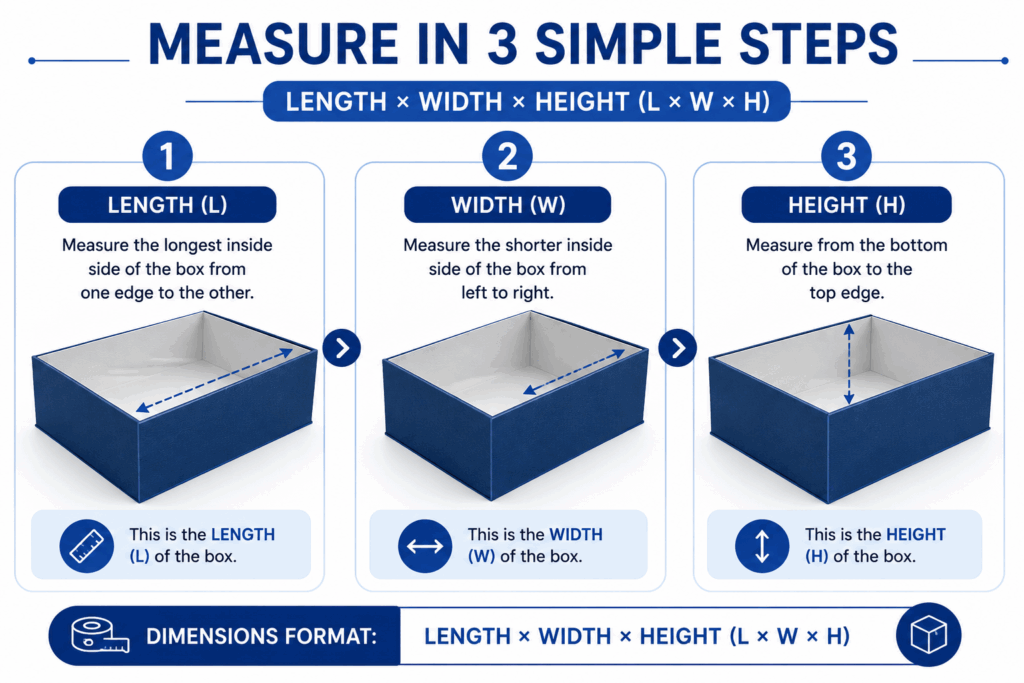
Accuracy in measuring the rigid box is very important before making an order for packaging. Manufacturers usually stick to the following measurement process that is accepted by all of them:
Length x Width x Height (L x W x H)
Here’s how you should make accurate measurements.
Step 1: Measure the Length
The length is the longest side of the box opening and should be measured from one inside edge to the other inside edge.
Step 2: Measure the Width
The width is the shorter side of the box opening and is measured from left to right inside the box.
Step 3: Measure the Height
The height is measured from the bottom of the box to its upper edge. This parameter defines how deep the product will go into the packaging.
Pro Tip: Most packaging manufacturers use internal dimensions because they determine how well the product fits inside the box. Always confirm whether your supplier requires inside or outside measurements before production.
Standard Rigid Box Sizes
Although custom rigid boxes can be manufactured in virtually any size, certain dimensions are commonly used across industries.
| Product Type | Common Rigid Box Dimensions |
| Jewelry | 3″ × 3″ × 1.5″ |
| Watches | 4″ × 4″ × 3″ |
| Perfumes | 6″ × 4″ × 2″ |
| Cosmetics | 8″ × 6″ × 3″ |
| Chocolate Gift Boxes | 8″ × 8″ × 2″ |
| Apparel | 12″ × 10″ × 3″ |
| Shoes | 14″ × 10″ × 5″ |
| Electronics | 9″ × 7″ × 3″ |
| Gift Sets | 12″ × 10″ × 4″ |
| PR Kits | 14″ × 12″ × 4″ |
These dimensions serve as general references. The ideal size depends on your product, protective inserts, branding requirements, and packaging style.
How to Choose the Right Rigid Box Dimensions
Determining the ideal rigid box size is not just about measuring the product. A number of considerations need to be made to achieve an ideal result.
Measure Your Product Accurately
Begin by measuring your product’s:
- Length
- Width
- Height
If you will be packaging several products, it is important to measure the entire assembly instead of each unit separately.
A little extra room is provided to allow for inserts and reduce movement.
Consider Protective Inserts
Most luxury rigid boxes feature inserts made from foam, EVA, cardboard, molded pulp, or paperboard, which keep the products secured inside the box.
The inserts take up extra interior space, and hence they should always be considered in any calculation of packaging dimensions.
Account for Product Shape
Some products do not come in perfectly rectangular shapes. For instance, cylindrical-shaped bottles, electronics, jewelry, and promotional packages need customized inserts and different box dimensions for a snug fit.
Think About Presentation
A premium unboxing process may feature well-placed products, branded tissue paper, ribbons, thank-you cards, or other promotional pieces.
Reserving enough space for these branding components will enhance the customer experience without making the box too large.
Common Rigid Box Styles and Their Size Considerations
Different box styles require different dimensional planning.
Two-Piece Rigid Boxes
These traditional boxes have two parts – base and lid, which may be made separately. Normally, there is a slight tolerance for the lid, which means that it can fit comfortably without being too snug.
They can be employed for:
- Luxury gifting
- Apparel packaging
- Chocolate packaging
- Electronics
Magnetic Closure Boxes
This type of box design includes a lid with concealed magnets.
During the design of magnetic closure boxes, extra clearance will be needed for:
- Magnetic panels
- Hinged flap
- Inserts inside the box
Drawer Boxes
They may also be referred to as sliding boxes, which consist of an inner tray and an outer sleeve.
The tray should glide freely but not too loosely, meaning that there should be proper dimensional tolerances in manufacturing.
Shoulder Neck Boxes
They are highly elegant boxes that have a raised shoulder between the base and the lid.
Due to their layered design, there is a need for careful calculation of the dimensions of each part.
Understanding Grey Board Thickness and Box Dimensions
The material that is used in making rigid packing plays a part in determining its final dimensions.
Most rigid boxes are made of grey board, which comes in different thicknesses, such as:
| Grey Board Thickness | Recommended Applications |
| 1 mm | Lightweight retail products |
| 1.5 mm | Cosmetics and stationery |
| 2 mm | Apparel and gift boxes |
| 2.5 mm | Electronics and premium retail |
| 3 mm | Luxury packaging and PR kits |
The thicker the board used in making the box, the stronger it will be, although it will have an effect on the outside dimension of the box.
Custom vs. Standard Rigid Box Dimensions
The initial question faced by many businesses when developing rigid packaging involves choosing between using standard box dimensions and having custom rigid boxes designed. Although standard box sizes will suffice in certain cases, custom dimensions provide better flexibility, better protection, and a more elegant appearance.
Standard Rigid Box Sizes
Standard rigid box dimensions refer to pre-determined sizes that can be found in different industries. Standard sizes are usually a convenient solution for items that have standard shapes and dimensions.
Advantages of standard sizes include:
- Reduced manufacturing costs
- Increased production speed
- Easy inventory management
- Applicable to readily available products
But standard sizes might result in empty spaces within the box, thus necessitating extra fillers or inserts.
Custom Rigid Box Dimensions
The size of custom rigid boxes is always based on your product’s size. All aspects, from the inner cavity to the outer surface of the box, will be custom-made according to your needs to ensure that your product gets the right fitting.
Advantages of custom sizing include:
- Improved product protection
- Reduced movement during transportation
- Improved efficiency in terms of materials used for packaging
- Improved customer appeal
- Brand identification
- Minimal requirement of void fill
Luxury products mostly prefer custom rigid boxes for unboxing and presentation purposes.
How Interior Inserts Affect Rigid Box Dimensions
Most premium boxes come with inserts to hold the products firmly in position. Though inserts enhance the protection and presentation, they do affect the size of the finished rigid box.
Types of inserts used in boxes are:
- EVA foam inserts
- Cardboard inserts
- Molded pulp inserts
- Paperboard dividers
- Lined satin/velvet trays
- Die-cut paper inserts
In measuring the internal size of your box, you must consider the thickness of your inserts.
For example, a perfume bottle displayed in a custom foam insert requires additional internal space compared to the bottle alone. Planning for inserts early in the design process helps avoid costly revisions later.
Shipping and Storage Considerations
An appropriate rigid box size not only protects the product but also optimizes logistics and saves on operational expenses.
Optimize Shipping Costs
Many shipping companies use dimensional weight to charge rates. Larger boxes may cost more in freight charges despite having a light product.
With the right packaging dimensions, a company can:
- Save on shipping charges
- Maximize space on a pallet
- Cut storage costs
- Reduce extra packaging materials
Stackability
Boxes with uniform dimensions can be stacked easily in warehouses as well as while transporting. The dimensions play an important role in preventing the boxes from being crushed as well as maximizing the warehouse space.
Product Protection During Transit
The products that are shipped long distances face issues such as vibrations, compression, and multiple handling. Proper rigid packaging with the help of inserts can prevent movements in the product.
Common Mistakes to Avoid When Choosing Rigid Box Dimensions
Even good packaging design may fail due to the wrong dimensions used. The following tips will help to avoid making any mistakes with packaging design.
Measuring Only the Product
It is essential not just to measure the product but also to take into account the additional items that you may wish to include in the package, such as insertions, protection material, instruction booklets, ribbons, or promotional cards.
Ignoring Material Thickness
Grey board thickness impacts the final size of the box. Internals and externals have different dimensions, particularly when thicker boards are used to manufacture the luxury rigid boxes
Leaving Too Much Empty Space
A large box creates room for movement during transit, which is likely to cause damage. Also, too much space inside a box makes it appear inferior.
Choosing Style Before Size
The style of the box is supposed to match the size of the product, not vice versa. For instance, if your box has a magnet closure system, shoulder neck, or drawers, you need extra structural room that you will consider from the start.
Forgetting Future Packaging Needs
When you want to have seasonally themed cards, thank you notes, or any other special insertions within your product in future launches, you may think of having a little flexibility.
Recommended Rigid Box Dimensions by Industry
While every product is unique, the following dimensions provide a useful starting point for common applications.
| Industry | Suggested Rigid Box Dimensions |
| Jewelry | 3″ × 3″ × 1.5″ to 5″ × 5″ × 2″ |
| Cosmetics | 6″ × 4″ × 2″ to 8″ × 6″ × 3″ |
| Perfume | 5″ × 3″ × 2″ to 7″ × 4″ × 3″ |
| Watches | 4″ × 4″ × 3″ |
| Apparel | 12″ × 10″ × 3″ |
| Shoes | 14″ × 10″ × 5″ |
| Electronics | 9″ × 7″ × 3″ to 12″ × 9″ × 4″ |
| Chocolate Gifts | 8″ × 8″ × 2″ |
| Corporate Gifts | 14″ × 12″ × 4″ |
| PR Kits | Custom dimensions based on product assortment |
These sizes are examples and should always be adjusted to fit your product, inserts, and branding requirements.
Tips for Designing the Perfect Luxury Rigid Box
For creating an attractive and effective package design, the following tips must be followed:
- Measure the size of your products before designing the box.
- The selection of grey board must be done keeping the weight and value of the products in mind.
- Provide protection inserts wherever needed.
- Give some space for removing the products while ensuring there isn’t too much wasted space.
- Choose high-end finishes like foil stamping, embossing, debossing, soft touch lamination, or spot UV to make the packaging more valuable.
- Conduct testing of prototypes before mass production.
Final Thoughts
Final Thoughts
Choosing the proper dimensions of your rigid boxes requires more than just picking a box to fit your products. Proper sizing has an impact on protection, logistics, cost of production, sustainability, and overall consumer experience.
If you choose to create luxury rigid boxes for your cosmetics, electronics, clothing, jewelry, and corporate gifts, then taking the extra time for measuring and creating the packaging design will benefit you.
By learning how to calculate rigid box dimensions, how to choose the right grey board thickness, how to include the inserts, and how to choose the best box style, you will be able to create high-quality packaging that represents the quality of your brand and satisfies customer expectations. If you want to design custom rigid boxes in the USA, then Blue Box Packaging is here for you. We provide you with completely customizable packaging solutions suitable for your products and dimensional specifications.
FAQs
What are the standard rigid box dimensions?
The common sizes vary since rigid boxes can be made to accommodate various products. Some sizes include 3″ x 3″ x 1.5″ for jewelry and 14″ x 10″ x 5″ for shoes and gifts that are bigger.
How do I measure a rigid box correctly?
The dimensions must be measured by their internal length x width x height (L x W x H) unless otherwise specified by your packaging supplier.
What thickness of grey board is best for rigid boxes?
Grey board with a thickness between 2 mm and 3 mm is the best choice for most cases of premium packaging due to the combination of good resistance, look, and sturdiness offered. Thicker grey boards should be used for heavier products.
Should I choose standard or custom rigid box dimensions?
Custom dimensions are preferable when the item being packaged has unique dimensions or where a high-end impression is required.
Why are accurate box dimensions important?
Accurate dimensions provide good protection for your products, minimize shipping costs, optimize storage, and make your packaging look professional.

James Clark
James is a senior editor, expert in the packaging industry. With a keen eye for detail and industry expertise, he crafts engaging narratives that explore the latest trends and innovations in packaging design and sustainability.