
Flexographic Printing Solutions for Modern Packaging
The packaging industry is undergoing a massive transformation. Walk down any retail aisle or unbox an e-commerce delivery, and you will see that packaging is no longer just a protective shell. It is a powerful brand touchpoint, a silent salesman, and a key factor in a company’s sustainability footprint.
As brands strive to balance stunning, eye-catching visuals with cost efficiency and eco-friendly practices, one manufacturing process consistently stands out: Flexographic printing (commonly known as flexo).
Far from being an outdated technique, modern flexo has evolved into a highly automated, precise, and sustainable printing powerhouse. Let’s dive into how flexographic printing works, why it dominates modern custom packaging, and how it stacks up against other mainstream choices.
What is Flexographic Printing?
At its core, flexographic printing is a modern adaptation of the letterpress printing process. It utilizes flexible, relief photopolymer plates wrapped around rotating cylinders to transfer quick-drying inks directly onto a moving web or sheet of material (known as the substrate).
Think of it as a highly sophisticated, industrial version of a rubber stamp, operating at incredible speeds. The flexible plates enable printing on almost anything – from ultra-thin plastic films and metallic foils to thick corrugated cardboard and rustic Kraft paper.
How the Process Works Step-by-Step
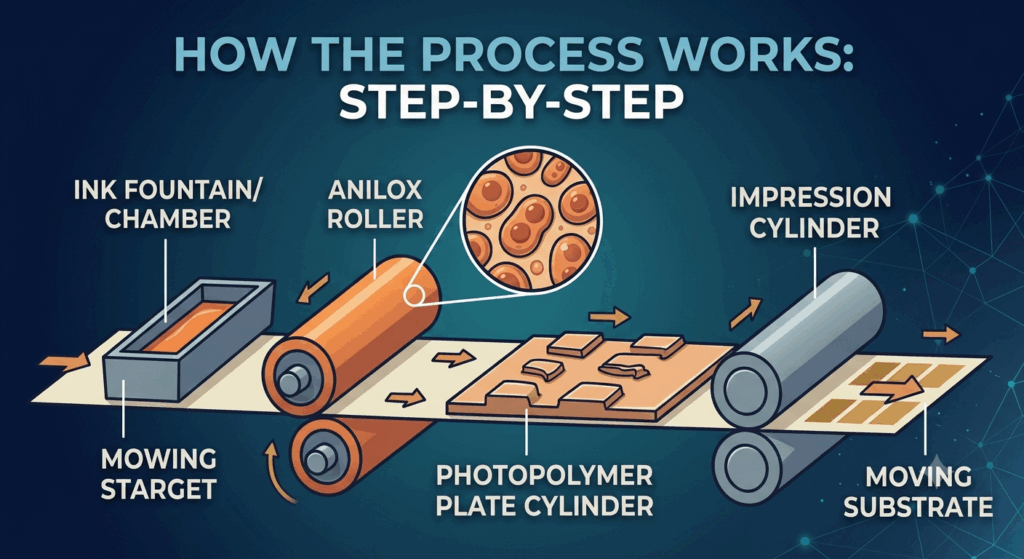
Understanding the inner workings of a flexo press helps clarify why it is so efficient for large production runs. The process follows a distinct path through the printing press:
- Ink Application:
The ink resides in an enclosed chamber or fountain. A fountain roller or doctor blade system applies this ink to the anilox roller.
- The Anilox Roller:
This is a finely engraved metal or ceramic cylinder containing millions of microscopic dimples (cells). It scrapes away excess ink, ensuring that an exact, uniform film of ink is delivered to the printing plate.
- The Plate Cylinder:
This cylinder holds the flexible photopolymer plate, which features the raised image or text of your design. As it rotates against the anilox roller, it picks up the precise layer of ink.
- The Impression:
The substrate passes between the plate cylinder and a smooth impression cylinder. The impression cylinder applies just enough pressure to transfer the crisp ink image from the plate onto the material.
- Drying and Finishing:
The material passes through inline dryers (using hot air, infrared, or UV/LED curing) so the ink sets instantly. Many modern setups handle cutting, laminating, and creasing in this exact same continuous pass.
Why Flexo Dominates Modern Packaging
Packaging manufacturers and global brands rely heavily on flexography for several distinct reasons:
1. Unmatched Speed and Production Scalability
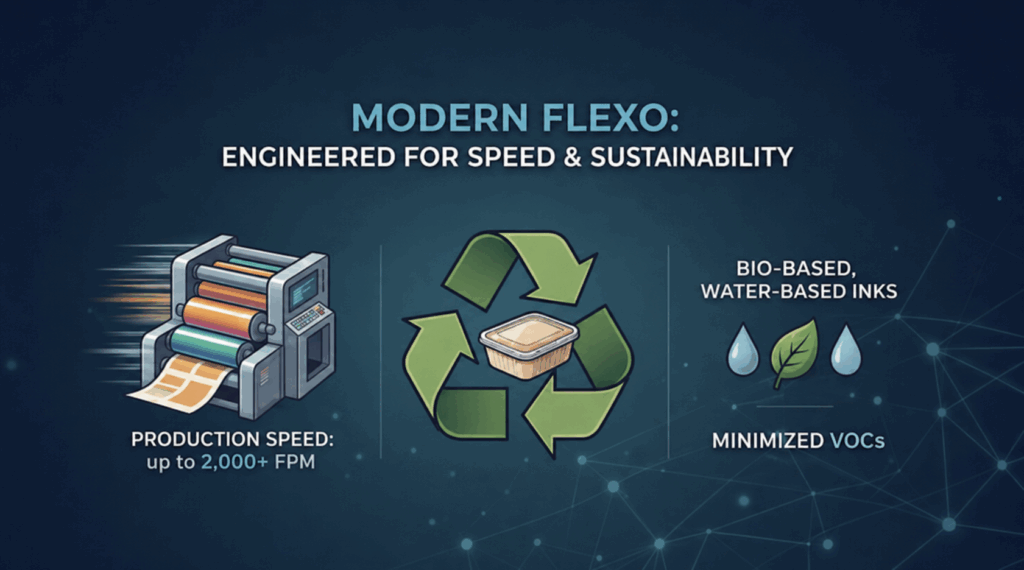
Flexo presses are built for high-volume manufacturing. Running at speeds of 500 to over 2,000 feet per minute, a flexo press can produce hundreds of thousands of custom folding cartons, mailer boxes, or labels in a single shift. Once the initial setup is complete, the operational cost per unit drops drastically.
2. Extreme Material Versatility
Unlike offset printing, which requires flat, rigid sheets of paperboard, flexo adapts to the material. It works seamlessly on:
- Porous Substrates: Corrugated board, brown Kraft paper, and folding paperboard.
- Non-Porous Substrates: Polyethylene films, cellophane, metallic foils, and flexible plastics used in food pouches.
3. Sustainable and Eco-Friendly Clean Printing
The modern packaging landscape is driven by the green movement. Flexography aligns perfectly with this shift because it works beautifully with water-based and bio-derived inks (such as soy, biochar, or algae-based variants). These alternatives release minimal Volatile Organic Compounds (VOCs), making the production line safer for operators and creating food-safe, highly recyclable packaging.
Comparing Printing Technologies
Choosing the right method depends entirely on your project’s volume, material, and budget. The table below outlines how flexography compares to Digital and Offset printing in the current manufacturing landscape.
| Feature | Flexographic Printing | Digital Printing | Offset (Lithography) Printing |
| Best Suited For | High-volume production, flexible packaging, corrugated boxes. | Short runs, prototyping, variable data/personalization. | High-end retail packaging, luxury rigid boxes, magazines. |
| Setup Cost & Time | High (requires custom photopolymer plates). | Extremely Low (direct from digital file to press). | High (requires custom metal plates and chemical balancing). |
| Cost Per Unit (Long Run) | Lowest | High (remains constant regardless of volume). | Low |
| Material Flexibility | Highest (Paper, film, foil, thick corrugated). | Medium (Primarily thin paper, labels, specific treated films). | Medium (Flat paperboard sheets only). |
| Ink Types Used | Water-based, solvent, UV/LED, bio-derived inks. | Toner or specialized inkjet inks. | Oil-based or UV-curable heavy inks. |
Key Components of a Modern Flexo Solution
To achieve pristine print quality without color shifting or smudging, four pillars must work in harmony:
Advanced Photopolymer Plates
The industry has transitioned away from rubber plates toward digital photopolymer plates. These plates are imaged using high-resolution lasers, allowing them to hold intricate halftone dots and fine text. This development ensures sharp gradients and crisp branding elements, even on rough surfaces like corrugated Kraft paper.
Anilox Roller Engineering
The cell volume and line screen count (cells per linear inch) of the ceramic anilox roller must match the artwork design. Fine, detailed text requires a higher line count to transfer smaller amounts of ink, while bold solid colors need a deeper cell volume for full, vibrant coverage.
Smart Ink Systems
- Water-Based Inks: The go-to option for corrugated shipping boxes and Kraft bags. They dry via evaporation and absorption, offering excellent recyclability.
- UV and LED-Curable Inks: Ideal for premium labels and cosmetics packaging. They dry instantly under specific light wavelengths, producing a high-gloss, scuff-resistant finish.
Common Press Configurations
Flexo machines come in three primary structural designs, each tailored to specific types of packaging goods:
Central Impression (CI) Press
In a CI setup, multiple color stations are arranged around a single, large central impression cylinder. Because the substrate is held tightly against this central wheel, it cannot stretch or shift between colors.
- Best For: Thin, stretchy plastics, flexible food pouches, and precise multi-color registration.
Inline Press
Here, independent printing units are placed sequentially in a straight horizontal line.
- Best For: Heavy-duty substrates like corrugated cardboard, folding cartons, and labels that require inline die-cutting or foil stamping.
Stack Press
The printing stations are stacked vertically on top of each other. This setup provides accessibility for operators and allows printing on both sides of the substrate in a single pass.
- Best For: Simple gift bags, industrial sacks, and wrappers where ultra-fine detail isn’t the primary goal.
Flexographic Printing Across Different Industries
Take a look around your kitchen or office – chances are, most of the packaged goods you see were printed on a flexo press. Thanks to its speed and ability to handle difficult surfaces, flexography is the invisible backbone of several massive markets.
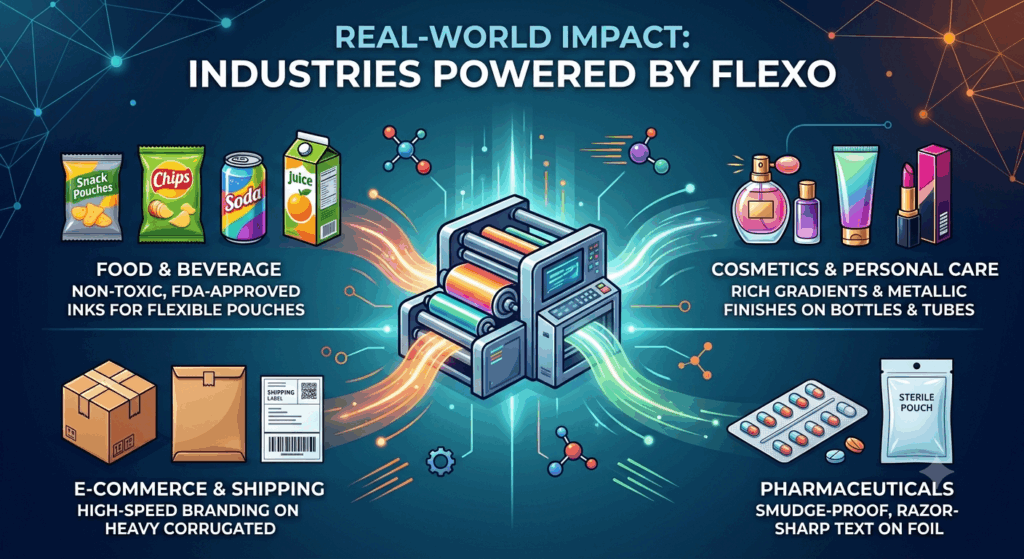
- Food & Beverage: This is flexo’s biggest playground. Because it pairs perfectly with odor-free, non-toxic, FDA-approved water-based inks, it is the standard for chip bags, juice cartons, candy wrappers, and flexible snack pouches.
- E-Commerce & Retail Logistics: Online shopping demands tough, branded packaging. Flexo presses handle thick, abrasive corrugated cardboard and rustic Kraft paper effortlessly, printing thousands of subscription and shipping boxes per hour.
- Cosmetics & Personal Care: High-end beauty products require a premium feel. Modern flexo prints rich, vibrant colors and metallic finishes directly onto squeeze tubes, shampoo bottles, and glossy cosmetic boxes.
- Pharmaceuticals: Accuracy is non-negotiable here. Flexo delivers razor-sharp, smudge-proof text on non-porous materials like foil blister packs and medical pouches, ensuring dosage instructions remain perfectly legible.
Hybrid Printing: The Future of Packaging
The latest boundary-pushing trend involves Hybrid Flexographic-Digital systems.
By pairing the structural stability, raw speed, and low cost of a flexo press with an inline digital inkjet unit, converters get the best of both worlds. Brands can run massive high-volume packaging batches using flexo for the base structural design, while using the digital component to instantly print variable data, track-and-trace QR codes, or localized promotional messaging without stopping the line.
This hybrid workflow addresses the growing demand for smart, interactive packaging while keeping production margins secure.
Final Thoughts: Is Flexographic Printing Right for Your Brand?
If you are launching a boutique brand requiring small, hyper-personalized batches of 200 boxes, digital printing remains your smartest starting point.
However, if your business is scaling up and you are ordering custom mailer boxes, retail folding cartons, or flexible product pouches by the thousands, flexographic printing is the gold standard. It offers an unbeatable combination of blistering speed, massive material compatibility, and a lower environmental footprint—ensuring your packaging stands out on the shelf while protecting your bottom line.
FAQs
1. What is flexographic printing?
Flexographic printing (or flexo) is a high-speed industrial printing method that uses flexible, raised relief plates wrapped around rotating cylinders to stamp quick-drying inks directly onto a moving material.
2. How does a flexo press apply ink accurately?
It relies on an anilox roller, which is a specialized ceramic cylinder engraved with millions of microscopic cells. This roller scrapes away excess ink to deliver a perfectly uniform, micro-thin layer to the printing plate.
3. What types of packaging materials can flexo print on?
Flexo is highly versatile and handles both porous and non-porous surfaces. It prints seamlessly on corrugated cardboard, Kraft paper, folding cartons, plastic films, cellophane, and metallic foils.
4. What are the three main types of flexo press configurations?
Central Impression (CI): Best for thin, stretchy plastics because materials don’t shift.
Inline: Best for thick corrugated boxes and labels that need cutting in a straight line.
Stack: Best for simple bags and wrappers where printing on both sides is needed.
5. Why is modern flexo considered an eco-friendly printing choice?
Unlike traditional oil-based systems, modern flexography pairs perfectly with water-based and bio-derived inks. These formulations release minimal Volatile Organic Compounds (VOCs), making the packaging safer to produce and highly recyclable.

James Clark
James is a senior editor, expert in the packaging industry. With a keen eye for detail and industry expertise, he crafts engaging narratives that explore the latest trends and innovations in packaging design and sustainability.