
What Is Aqueous Coating? A Complete Guide to Printing Finishes
When it comes to the world of custom box printing, being different from the competition on the store shelf means more than having an excellent structure and great graphics. The appearance and sensation created by your box make all the difference in terms of the impression it makes. This is where you can rely on print finishes to help differentiate your business.
While there are many other solutions in the print finishing industry, there is one that stands above all others when it comes to its aesthetically pleasing features, its protection capabilities, and its eco-friendly nature. We are talking about Aqueous Coating (AQ).
When creating your retail, cosmetic, or mailer boxes, it is essential to understand the protection provided by AQ. This comprehensive guide by BlueBox Packaging will teach you everything you need to know about aqueous coating.
What Is Aqueous Coating?
The aqueous coating refers to a liquid film that quickly dries using water base. The coating is put on the printed sheets of paperboard as they go through the process of offset printing. The coating serves as a protective coating for the ink underneath, improves the durability of the paper, and gives the paperboard a unique look, whether shiny or velvety.
The coating is green because it uses water as a solvent instead of petroleum or chemical solvents. The coating is environmentally friendly due to its low level of Volatile Organic Compounds (VOCs).
The Anatomy of an AQ Coating Layer
For efficient high-speed drying and high-quality scuff protection, the formulation is made up of the following components:
- Water Carrier: serves as the liquid carrier that will evaporate easily during the process of drying.
- Water-Soluble Polymers: includes acrylic polymers and polyurethane that will be able to bond to form the film.
- Performance Additives: special types of wax and surfactants for optimal performance.
How Does the Process Work?
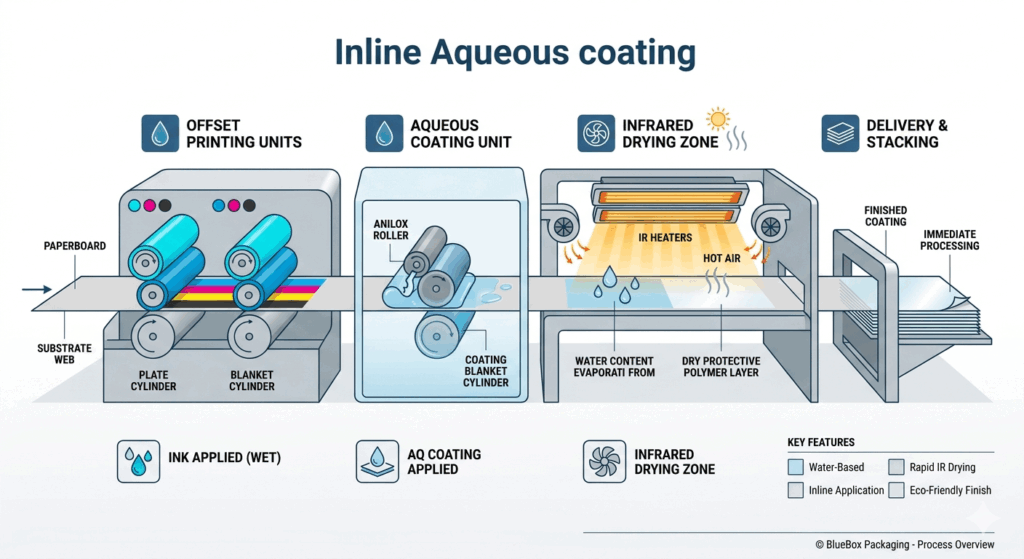
Unlike earlier forms of finishes that needed printed sheets to become completely dry before applying any coatings to them, aqueous coatings are done in-line, in one go, during the press run.
The inline coating machine processes happen as follows:
Ink Application: The sheets of paperboard pass through conventional print units where the images are printed using ink.
Coating Unit: While the ink is still wet on the paper, the coating process is performed using special anilox rolls or special blankets that apply a liquid coating on top of the print.
Rapid Evaporation Drying: The coated sheets pass through an IR dryer and air heater. Due to the rapid evaporation process, water becomes a gas, leaving the polymer chain to join and form a hard coat.
Since drying is fast, the coated sheets can immediately be sent to die-cutting and folding units without the worry of smudging, ink offset, or sticking together.
Types of Aqueous Coating Finishes
Depending on your branding requirements, different formulations can be used to alter the visual and structural traits of your packaging finishes.
| Coating Type | Visual Effect | Best Used For | Tactile Feel |
| Gloss Aqueous Coating | High reflective shine, deep color vibrancy | Fast-acting retail boxes, electronics, toys | Smooth, sleek, and highly polished |
| Matte Aqueous Coating | Non-glare, subdued reflection | Luxury cosmetics, high-end apparel, gourmet food | Subtle, clean, and elegant |
| Satin Aqueous Coating | Semi-gloss moderate shine | Tech gear, pharmaceutical items, corporate kits | Balanced, professional satin tone |
| Soft-Touch Coating | Deep matte, zero reflection | Premium luxury brands, high-end jewelry, boutique gifts | Velvety, suede-like, premium soft feel |
Specialized and Niche AQ Variations
In addition to the four base types, more specific coatings have been developed for particular purposes in chemical engineering:
- Pencil-Receptive AQ: An interesting modification that has a slightly porous surface after drying. It gives the ability to write a date or tracking number on the box by hand using pencils or pens.
- Bleed-Resistant AQ: Special blend designed to ensure that inks of high color intensity, such as bright reds or dark blues, do not bleed through the clear finish film layer due to thermal changes.
- Primer AQ: Used as a base layer before high-gloss top coats or metallic foils can be applied to highly porous corrugated paper products.
Key Benefits of Aqueous Coating for Custom Packaging
The choice of finishes affects not only your profit but also how long your packaging is able to keep its clean appearance while being transported.
1. Strong Scratches and Marks Protection
During transportation, boxes rub each other inside shipping containers. With AQ coating, you can be sure that any friction will not leave unsightly marks on your boxes, such as finger marks or smudges.
2. Affordable Pricing
Since AQ coatings are applied in-line at fast printing speeds, there is no need for additional post-print processes. The production time and cost per box are significantly decreased by this process.
3. Superior Structural Flexibility
Whereas plastic laminates tend to weigh heavily on the substrate, this ultra-thin film bends freely with the paperboard substrate itself. Whether folded or scored into intricate box forms, the coating will remain unbroken around the edges.
4. Eco-Friendly and Easily Recycled
Compliance with environmental standards has never been more critical. Since this coating is water-based, the paperboards coated with it may be readily pulped and recycled within standard waste treatment processes.
Aqueous Coating vs. Other Finishes
When deciding on a final treatment, brands often evaluate UV coating vs aqueous coating or older traditional oil varnishes. Here is how they stack up side-by-side:
| Performance Characteristic | Aqueous Coating (AQ) | UV Coating | Traditional Varnish |
| Base Compound | Water-based polymers | Photopolymer chemical resins | Oil-based ink compounds |
| Curing Method | Infrared heat air evaporation | Ultraviolet light activation | Oxidation slow-air dry |
| Gloss Intensity | Medium to High | Extremely High (Mirror shine) | Low to Medium |
| Eco-Friendliness | Excellent (Fully recyclable) | Moderate (Chemical heavy) | Low (High VOC emissions) |
| Yellowing Resistance | Excellent (Stays clear) | Good | Prone to yellowing over time |
| Write-ability | Yes (With specific variants) | No (Too slick for ink/glue) | Yes |
Aqueous Coating vs. Varnish: What’s the Difference?
However, despite similarities, these printing coatings have significant distinctions in their chemistry, processing speed, and durability.
Material Composition and Odors: Regular varnish is an oil-based clear ink, which contains highly volatile Volatile Organic Compounds (VOCs) with a noticeable smell. On the other hand, AQ is a water-based solution with nearly zero VOCs, meaning it has no odor at all.
Drying & Turnaround: Drying is rather a lengthy process for varnished printing because it takes place through air oxidation; thus, one must wait up to 24 or 48 hours before die-cutting. The AQ solution is dried instantly by passing under IR lamps after the printing process.
Aesthetics & Aging: Oil-based varnish becomes yellowed due to the oxidation process, and changes the colors of the packaging. In contrast, AQ provides better yellowing resistance while having excellent scuff-resistance properties.
Applications for Aqueous Coating
Being highly adaptable and water-based, it has earned itself wide acceptance in the field of printing due to its durability and safety features. Here are some major segments of custom packaging and commercial print that utilize this finish:
- Food and Beverages: FDA-compliant AQ coating is used extensively on indirect contact products such as cereal boxes, takeaway containers, and frozen food boxes.
- Cosmetics and Luxury Goods: The matte and soft touch coatings create a high-end appearance on perfume boxes, skincare packaging, and jewelry boxes.
- Retail and Electronics: Glossy AQ coating is perfect for durable boxes, toy packaging, and electronics gadgets packaging. This is because of its ability to enhance color depth and scuff resistance.
- Pharmaceuticals: Its odorless and low VOC composition makes it suitable for use in medicine box packaging.
- Commercial Print: In addition to boxes, it also offers protection for various commercial print products such as company brochures, postcards, and catalogs.
Key Factors When Choosing Your Print Finish
Consider the following operational factors when selecting your substrate, before placing your final print order:
- Weight and Absorbency: Lighter papers may be prone to buckling when applied with large amounts of liquid. AQ is ideal on heavier paperboards, specifically 14 pt through 24 pt and above, to ensure they hold their shape when being quickly dried by heat.
- Downstream Finishing Requirements: In the event that you require your structure to have windows patched, glued tabs, or metallic stamps, typical AQ formulations can disrupt the adhesion process in these areas. Ensure to include glueable/stampable versions of the finish where needed.
- Shipping and Logistics Stress: Should your product line endure extensive shipping via sea and encounter high friction during this process, selecting either a high-rub gloss or satin AQ finish will prevent any disruption to the ink underneath.
Final Thoughts
Selecting the appropriate printing finish is the last but essential step in converting plain cardboard into an effective brand ambassador. The aqueous coating serves as the best combination for today’s contemporary brands since it ensures that your packaging withstands the rigors of transportation while still looking impeccable on store shelves. And best of all, the environmentally friendly coating technology ensures that you accomplish all sustainability goals without compromising on the appearance or cost of your printing process. Be it a luxurious soft touch finish that adds class to your product or a glossy retail box that commands attention at first glance, the appropriate aqueous coating will ensure that it reaches its destination looking flawless.
FAQs
What is aqueous coating used for?
It is a clear, protective, water-based coating applied to prevent printed packaging, boxes, and promotional materials from getting scratched or fingerprinted, while giving certain gloss/matte effects.
Is aqueous coating environmentally friendly?
Yes. Since it is water-based and contains only minimal amounts of chemicals, it is completely recyclable and biodegradable. Paperboard treated with aqueous coating goes straight into your ordinary recycling bin.
Is aqueous coating suitable for food packaging?
Yes. Due to its non-toxicity, lack of volatile organic compounds, and odorlessness, certain FDA-approved variations are ideal for pharmaceutical and food contact packaging.
Does aqueous coating make packaging waterproof?
No. Although the coating offers excellent protection against humidity, minor exposure to moisture, and smudges, it will not completely seal the box. Complete waterproofing is only possible through plastic lamination.
Can you print or glue an aqueous coating?
While gloss coatings tend to be challenging when it comes to printing or gluing onto, “glueable” or “stampable” types specially engineered for packaging glues and metallic foil stamping exist.

James Clark
James is a senior editor, expert in the packaging industry. With a keen eye for detail and industry expertise, he crafts engaging narratives that explore the latest trends and innovations in packaging design and sustainability.